AWM
The table roller mill with integrated classifier permits the energy-efficient comminution of mineral raw materials at high throughput rates. The machine can also be used for combination grinding and drying.
- Table roller mill for end-product fineness values of between approx. 20 µm and 100 µm
- Preferred fineness range d97 = 50 µm
- Grinding roller liners and grinding table made of special wearproof castings
- Conical grinding rollers, hydraulic positioning mechanism
- Turboplex ultrafine classifier integrated into top section of mill
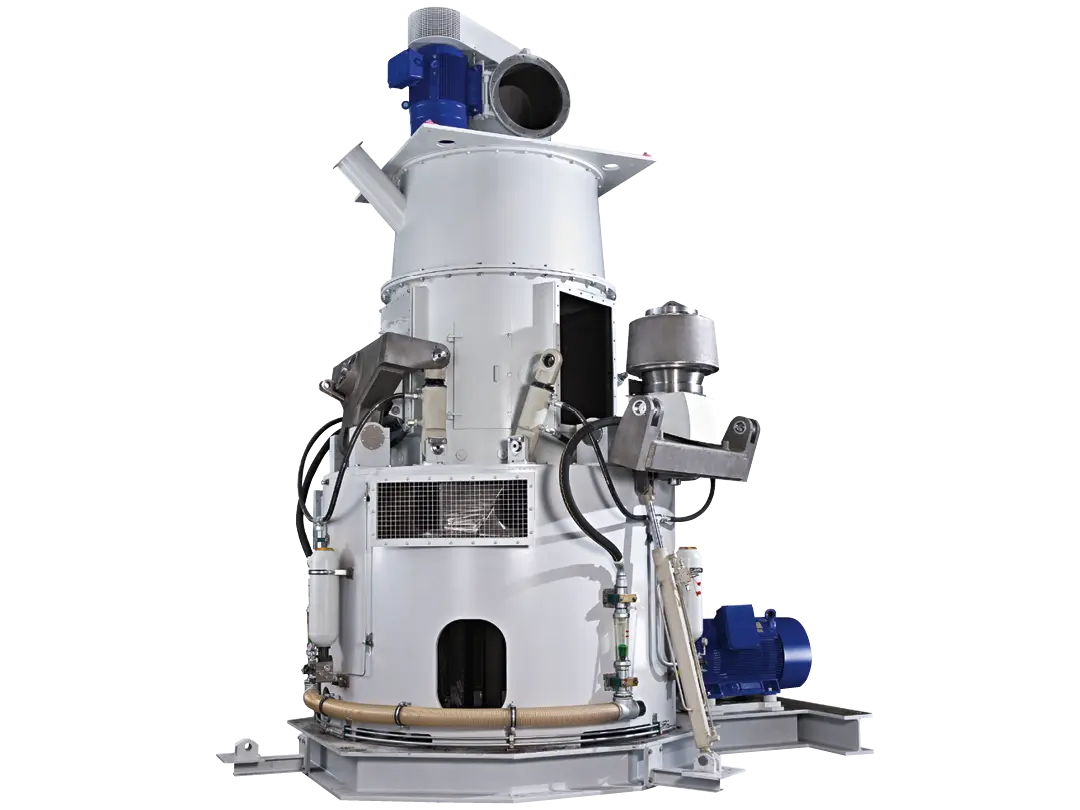
Table roller mills operate in accordance with the principle of pressure comminution, making them suitable for brittle but elastic feed products. The product is subjected to compressive stress between the grinding table and the grinding rollers. The specific grinding force (contact force divided by the cross-sectional area of the grinding roller) is in the range between approx. 0.5 and 1 N/mm², whereby the effective pressures in the material bed are naturally much higher. The grinding table is set into rotation by a motor and suitable gear unit, peripheral speeds of between 2 and 6 m/s are used. Because the gear unit has to absorb the forces of the grinding rollers, it is equipped with an axial friction bearing (segmented bearing).
The product is fed to the centre of the grinding table where centrifugal force conveys it across the grinding table to the periphery. The grinding rollers roll over the product repeatedly during this time and crush it. The grinding rollers are pressed hydraulically against the grinding table, where the fluctuations that occur in operation are buffered by the hydraulic gas accumulator charged with compressed air. The grinding table is equipped with a weir at its edge; the height of the weir can be chosen to set the residence time of the product in the grinding zone. A nozzle ring is located around the grinding table from which the incoming air exits at high speed. The comminuted product is conveyed upwards to the integrated air classifier; the rejected coarse material is returned to the grinding table for further comminution. The end product is separated from the air in a downstream collection unit.
A fundamental feature of Alpine's table roller mill is the optimised kinematics of the grinding rollers and grinding table to permit the production of large amounts of fines. In combination with a Turboplex ultrafine classifier ATP, this now makes it possible to manufacture end products with a table roller mill that have a fineness of d97 = 20 µm.
- Three grinding rollers, each with two hydraulic cylinders to generate the requisite compressive force
- Rollers can be hinged out hydraulically
- Wear parts are easy to exchange
- Compact design
- Combined bevel and spur or planetary gear units for the grinding table drive
- Highly wear-resistant construction materials for grinding table and grinding roller jacket are standard
- Low specific grinding energy
- Integrated air classifier with sharp top-size limitation; selection of classifier to suit the desired end-product fineness
- Fineness range between d97 = 20 – 100 µm
- Mill drive with frequency converter to permit optimum adaptation of the mill to a wide range of particle sizes
- Mill control by means of the drive power or differential pressure monitoring
- Option: hardfaced plates as wear protection in the mill and classifier housing
- Option: design for hot-gas mode to dry the product
- Option: discharge of coarse material via a discharge screw
Table roller mills are robust and time-proven mills for soft to medium-hard mineral raw materials and industrial bulk materials. The advantages of the table roller mill are the simple fineness adjustment and fast product change. Table roller mills are used wherever a high degree of production flexibility is demanded, for example for:
- Limestone
- Gypsum
- Dolomite
- Talc
- Petroleum coke
- Bentonite
- Quick lime
- Grinding table: Segments made of chilled iron castings. Additional wear-protection measures can be taken, e.g. harder cast alloys, if the product is particularly abrasive. Table supported in self-aligning roller bearings.
- Grinding rollers: Made of chilled iron castings. Harder cast alloys or hard facing are available for particularly abrasive products. Can be lifted hydraulically to permit maintenance. Roller arms are equipped with special seals.
- Nozzle ring and weir: Hard alloyed steel (NAXTRA)
- Housing: Wear protection inside housing made of hard alloyed steel (NAXTRA).
- Drive / gear unit: Planetary or combined bevel and spur gearing equipped with water- or air-cooling. If the requirements are particularly severe, lubrication of the segmented bearing can be assisted by a hydrostatic lubrication system. The machine is driven by a three-phase motor. But if a frequent fines change is an objective, a frequency converter can be employed for continuous optimisation of the grinding table speed. The grinding rollers raise briefly as the mill runs up to power, thus relieving the load on the drive and making a hydraulic starting clutch unnecessary.
- Nozzle ring, weir, cone: To permit fluidisation of the product, which has a considerable influence on the specific energy consumption, the weir is equipped with a nozzle ring. A cone in the lower section of the classifier facilitates smooth and quiet operation. In addition, the cone also permits production of a second particle fraction in combination with a screw conveyor as well as the removal of abrasive constituents.
- Roller arm, table shape, hydraulics: Every machine size has three roller arms, each of which is separately supported and arranged symmetrically at a 120° angle to each other. The grinding force is transmitted by means of two hydraulic cylinders per roller arm. The pressure of the cylinders is adjustable to achieve the product requirements. The bearing of the roller arms is oil-lubricated. As an option for impact drying applications, the table bearings can be cooled using an oil circuit. The seal between the roller arms and the product is air-rinsed.
- Classifier: Depending on the requirements, there are two types of classifier heads available. The Alpine Turboplex ultrafine classifier is used for high fineness requirements to approx. d97 = 10 µm. The single-wheel and multi-wheel classifying concept permits the manufacture of end products with a high precision of cut which is extremely sharp by today’s standards. For coarser requirements of up to 300 µm, the Micron® separator is used. The extremely low system pressure drop is noteworthy. In both cases, the fineness can be set by changing the speed of the classifying wheel.