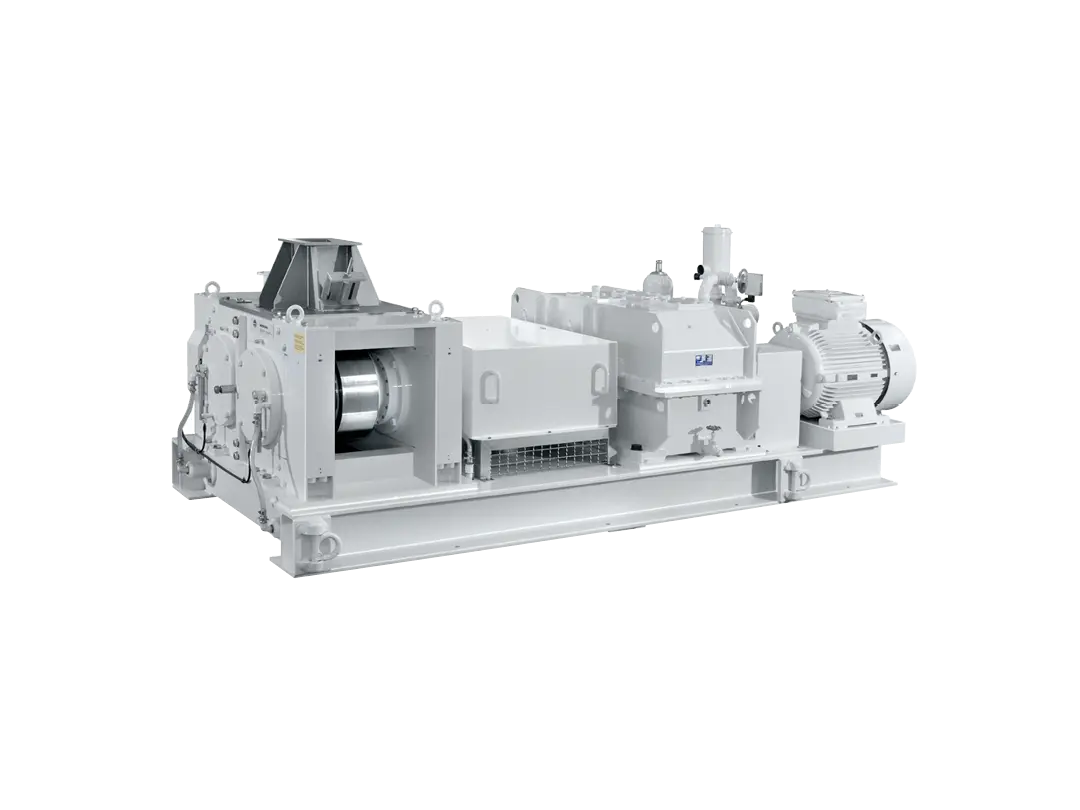
High-Pressure Roller Mill ECP
With High Pressure Roller Mills products are produced with a precipitous granule distribution.
The high pressure roller crusher is also called roller crusher or roller press.
Principle of operation
The mill feed is transported to the most narrow gap by the counter rotating rollers through friction effects. Both rollers are pressed against each other using hydraulics. This milling force is transferred to the mill feed. Through selective contact of the individual granules are created at extremely high inner tensions which lead to fractures.
The use of the optimal milling force leads to compact mills with extremely low energy requirements.
Because only the outer particles of the material bed have contact with the surface of the rollers, milling that is almost contamination-free is possible.
High Pressure Roller Mills are used in the cases of medium-fine crushing of hard materials such as ceramics, minerals from 5 up to 9 on the MOHS hardness scale, metals and metal alloys.
High Pressure Roller Mills ECP are used in continuous operation or in a closed circuit with screening machines or classifiers.
- Pre-crushing before fine grinding
- Non-fine crushing
- Sharp-edged granules
- Narrow granule distribution
- Roller diameter: 200 mm to 1,100 mm
- Working width of 50 to 1,200 mm
- Drive unit of 11 kW to 500 kW
- Gravity feeding
- Screw feeding for optimal throughput capacity
- Throughput capacity of 0.2 – 120 t/h
|
High Pressure Roller Mill ECP |
ECP 36 |
ECP 60 |
ECP 85 |
ECP 180 |
ECP 300 |
ECP 450 |
|---|---|---|---|---|---|---|
|
Max. press force (kN) |
360 |
600 |
850 |
1800 |
3000 |
4500 |
|
Roller diameter (mm) |
300 |
400 |
520 |
712 |
850 |
1100 |
|
Throughput in t/h |
0,5 - 1,2 |
0,8 - 5 |
2 - 8 |
5 - 15 |
8 - 30 |
20 - 80 |