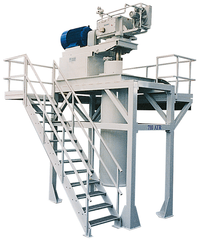
ATR (Dry grinding) agitated media mill
The ATR agitated media mill enables the ultra-fine dry grinding of challenging materials down to the micrometre range. Thanks to its high-performance grinding technology, low wear on the grinding beads and iron-free processing, it produces high-quality products with an impressive degree of whiteness – economically, reliably and precisely.
Key points at a glance
- Dry media mill for superfine products with finenesses to approx. 80% <2µm and a high specific surface
- Double-walled mill housing to permit water cooling
- The mill operates in circuit mode with Hosokawa Alpine Turboplex ultrafine classifiers

The peripheral speed of the agitator arms is about 2.5 – 3 m/s. At such low speeds, the energy introduced by the agitator is transmitted mainly by friction into the bed of material. A discharge screw at the lower end of the mill simultaneously extracts the blend of grinding beads and product. The grinding beads are separated with a screening machine and returned to the mill. Because of the high fineness values produced with the mill, virtually all products have a strong tendency to deposit, and a grinding aid needs to be added.
- Highest fineness values up to 90% < 2 µm with a downstream classifying step
- High capacity in relation to machine size, approx. 200 kW/m³ beads
- Compact design
- Iron-free grinding, high degree of whiteness
- Low peripheral speed, optimum energy utilisation, extremely reliable operation
- Low grinding media wear, low operating costs
- Extremely long service life of lining, low maintenance costs
Typical applications for ATR mills are mineral fillers, glazing raw materials and non-mineral hard materials. Examples: limestone, quartz, zircon sand, talc, ceramic colours and frits, titanium dioxide, etc.
- Minerals: The mill is used for the ultrafine comminution of mineral fillers or glazing raw materials. Aluminium oxide grinding beads with a diameter of 4 mm are employed in this case. The mill is lined with aluminium oxide and the arms of the agitator are protected by means of aluminium oxide tips to minimise wear and to keep the degree of whiteness in fillers as high as possible. The end product is produced in a downstream classifying circuit with the Turboplex air classifier ATP or the turbo-twin air classifier TTC, whereby the coarse material is returned to the mill via a weighing bin. The discharged fines are replaced constantly by new feed material.
- Starch deterioration:When baking bread rolls, it is advantageous if the dough has a high water absorption capacity. The amount of water absorbed by the ample starch in wheat flour can be increased by 20% if the flour is stressed in passing through the ATR. The external classifying step can be omitted in this case. The mill is filled with grinding beads made of special-grade steel for this application, and is not lined, merely the agitator arms are protected against wear by hardfacing. The mill jacket is cooled with water and the grinding beads are cooled by air after being separated from the flour and before they are returned to the mill. This is necessary in order to keep the temperature of the flour below 50° C.
- Depending on the product being processed, either aluminium oxide or other wearproof materials are used. Grinding beads of between 2 mm and 5 mm in diameter guarantee maximum energy intensity and an effective surface enlargement in the end product.
- The product can be coated during grinding, which makes the normally required grinding aid unnecessary.
Where the ATR is used