
Picoline
A stable platform, powerful software and numerous options:
- Machine for fine grinding, classifying or mixing powders in laboratories
- Especially for processing very small product quantities of a few millilitres
- Compact and modular design with numerous functional modules
- Separation of control and work unit
- Consisting of four parts: Platform control, process platform, function modules and accessories

A laboratory system customised to your specific requirements
|
Module name |
Alpine machine type |
Size |
Fineness |
|---|---|---|---|
|
Piconizer |
Spiral jet mill (AS) |
AS 33 |
d90 < 20µm |
|
Picojet |
Fluidised bed opposed jet mill (AFG)FG) |
AFG 40 |
d97 < 5 µm |
|
Picosplit |
Classifier (ATP) |
ATP 20 |
d97 < 5µm |
|
Picozirk |
Classifier mill (ZPS) |
ZPS 20 |
d97 < 20 µm |
|
Picoplex |
Fine impact mill (UPZ with pin discs) |
UPZ 40 |
d90 < ca. 80 µm |
|
Picoplex |
Fine impact mill (UPZ with plate beater unit) |
UPZ 40 |
d90 ca. 120 µm |
|
Picocross |
High-speed fine impact mill C/CW |
C 40 |
d90 ca. 50µm |
|
Picocrush |
Hammer mill (HA) |
Ha 4/2 |
d90 < 0,5-1 µm |
|
Picobond |
Coating (Nobilta) |
NOB-80 |
|
|
Picobond |
Coating (AMS) |
AMS-80 |
|
|
Picomix |
Mixer (Cyclomix) |
CLX 0.1 |
Function modules

Picosplit ultra-fine classifier
Spatter-grain-free results in the entire separation area
- Combination of the classifying head with different types of grinders (coarse material hopper, jet mill, classifier mill) for maximum flexibility
- Classifying wheel and motor bearing gas flushed
- High precision of cut
- Compressed air or inert gas operation
- Space-saving design
- Easy handling
- Designs: Stainless steel and wear-protected (ceramic) version for contamination-free reprocessing, batch mode or continuous mode
- Classifying head based on the ATP air classifier from Hosokawa Alpine
Technical specifications
|
Separation range |
2 µm - 120 µm |
|---|---|
|
Classifying wheel diameter |
20 mm |
|
Classifying speed |
max. 60,000 rpm |
|
Total air volume |
max. 20 Nm3/h |

- Classification takes place according to the centrifugal counterflow principle in a rapidly rotating classifying wheel.
- The powder is dosed into the viewing chamber and transported to the viewing wheel by the air flow.
- Fine particles pass through the wheel, are discharged with the air and separated in a cyclone filter combination or in a filter.
- Coarse particles are rejected by the classifying wheel and collected in a collection container.
- The separating air is fed into the lower part of the housing via a paddle ring; this disperses the rejected coarse material and increases the separating efficiency of the separator.
- The separating cut is adjusted by varying the gas volume and the classifier speed.
1 Classifier wheel 2 Classifier drive 3 Process air 4 Coarse material container

Picozirk classifier mill
Sharp and easily adjustable cut point
- Mechanical impact mill with integrated classifier for dry fine grinding of soft to medium-hard materials with a steep particle size distribution
- Plate beater rotor with grinding track
- Sharp and easily adjustable separation line
- Cool and gentle grinding
- Compressed air or inert gas operation
- Motor bearing mill and classifier gas flushed
- Continuous operation
- Designs: Stainless steel and wear-protected (ceramic) variant
- The design and mode of operation largely correspond to the Zirkoplex ZPS classifier mill from Hosokawa Alpine
Technical specifications
|
Separation range |
15 µm - 120 µm |
|---|---|
|
Grinding to Mohs hardness |
3,5 |
|
Classifying wheel diameter |
20mm |
|
Grinding disc diameter |
40 mm |
|
Classifier speed |
max. 60,000 rpm |
|
Total air volume |
approx. 20 Nm3/h |
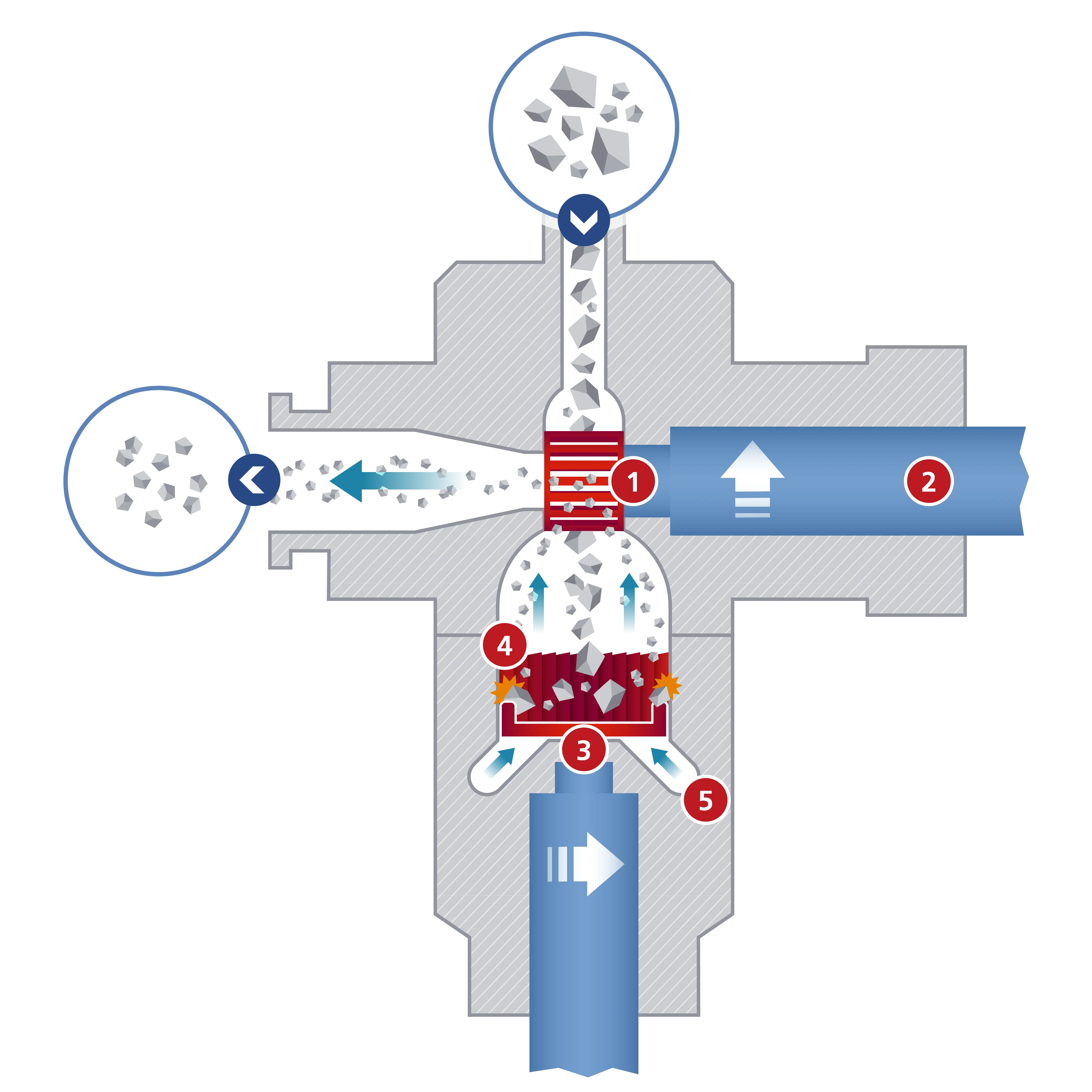
- Grinding is carried out by a rapidly rotating disc with grinding tools. The ground material is dosed into the grinding container and accelerated by the grinding rotor. Comminution is achieved by particle impact on the grinding tools of the rotor and by impact on the grinding track.
- The grinding air flows from below through the grinding gap between the rotor and the grinding track and then through the classifier wheel located in the head of the mill.
- Due to the classifying effect of the classifying wheel, fine particles can escape from the grinder with the air and are separated in a filter. Coarser particles fall back onto the rotor and are crushed further until they have reached the desired fineness.
- The classifier mill is adjusted via the speeds of the grinding rotor and the classifier wheel as well as via the gas volume.
1 Classifier wheel 2 Classifier drive 3 Beater disc 4 Grinding track 5 Process air

Picoplex impact mill
Universal grinder with flexible equipment
- Mechanical rotor impact mill for dry grinding of soft to medium-hard materials
- Continuous operation
- Filter element for venting
- Tubeless purge air supply
- Engine bearing gas flushed
- Stainless steel design
- Designs: Pin disc rotor or grinding track/plate beater combination
- The design and mode of operation largely correspond to the UPZ series from Hosokawa Alpine
Technical specifications
|
Separation range |
50 µm - 500 µm |
|---|---|
|
Grinding to Mohs hardness |
4 |
|
Rotor diameter |
40 mm |
|
Speed |
max. 60,000 rpm |
|
Propellant air volume |
max. 1 Nm³/h |

- The material to be ground is dosed into the centre of a rotor equipped with grinding tools and crushed by impact on the rotor and stator tools.
- After passing through the grinding zone, the ground material enters the mill housing and exits the mill by gravity. The rotation creates an air flow from which the ground material is separated in a filter.
1 Pin disc (stator) 2 Pin disc (rotor) 3 Grinding disc drive
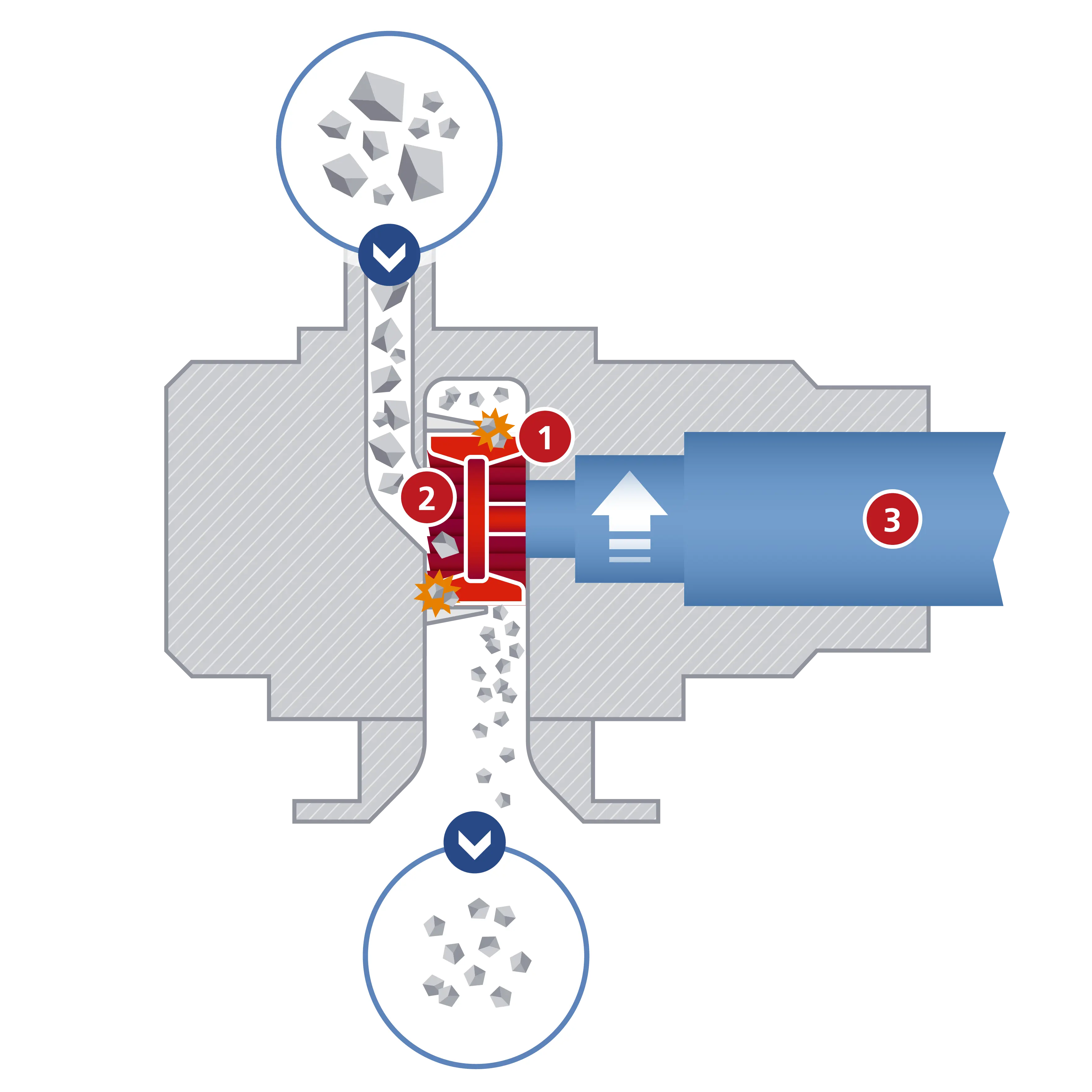
- Different grinding tools can be used, e.g. rotor/stator discs with axial pins or a plate beater rotor with a profiled grinding path or with a sieve.
- The fineness of the grinder is adjusted by the rotor speed and the feed rate.
1 Plate beater 2 Grinding track 3 Grinding tool drive

Picocrush hammer mill
Coarse or pre-comminution of soft to medium-hard materials
- Mechanical hammer mill for dry (pre-)comminution of larger granulates and agglomerates of soft to medium-hard materials
- Hammer mechanism with freely movable blow bars
- Grinding tool combined with grinding track and different sieve sizes for easy replacement
- Engine bearing gas flushed
- Tubeless purge air supply
- Continuous operation
- Stainless steel design
- Designs: Sieve inserts with different opening diameters, with suction to support the product feed
- The design and mode of operation largely correspond to the Ha hammer mill from Hosokawa Alpine
Technical specifications
|
Separation range |
1 - 3 mm |
|---|---|
|
Grinding to Mohs hardness |
4 |
|
Rotor diameter |
40 mm |
|
Speed |
max. 30,000 rpm |

- The ground material is dosed into the centre of two counter-rotating pin discs and crushed by impact against the grinding pins.
- The high shear rate of the counter-rotating discs enables particularly intensive stressing of the particles.
- After passing through the grinding zone, the ground material enters the mill housing and exits the mill by gravity.
- The rotation creates an air flow from which the ground material is separated in a filter.
- The grinder is adjusted by the speed of the two rotors and the feed rate.
1 Counter-rotating pin discs 2 Pin disc drive
Picocross counter-rotating pin mill
Ultra-fine impact grinding of soft to medium-hard materials
- 2-rotor counter-rotating impact mill with pin disc tool for dry grinding of soft to medium-hard materials
- Pin disc rotor with counter-rotating pin discs
- Engine bearing gas flushed
- Tubeless purge air supply
- Continuous operation
- Stainless steel design
- The design and mode of operation largely correspond to the Contraplex C series from Hosokawa Alpine
Technical specifications
|
Separation range |
30-500 µm |
|---|---|
|
Grinding to Mohs hardness |
4 |
|
Rotor diameter |
40 mm |
|
Speed |
2x max. 60,000 rpm |

- The ground material is dosed into the centre of two counter-rotating pin discs and crushed by impact against the grinding pins.
- The high shear rate of the counter-rotating discs enables particularly intensive stressing of the particles.
- After passing through the grinding zone, the ground material enters the mill housing and exits the mill by gravity.
- The rotation creates an air flow from which the ground material is separated in a filter.
- The grinder is adjusted by the speed of the two rotors and the feed rate.
1 Counter-rotating pin discs 2 Pin disc drive

Picojet fluidised bed opposed jet mill
Contamination-free comminution
- Fluidised bed counter jet mill with integrated classifier for contamination-free dry ultrafine grinding of medium-hard to extremely hard materials
- Steep grain distribution and sharp upper grain boundary
- Cool and gentle grinding
- Horizontal nozzle arrangement, nozzles integrated in housing extension
- Compressed air or inert gas operation
- Classifying wheel gap and motor bearing gas flushed
- Designs: Stainless steel and wear-protected (ceramic) version, batch mode or continuous mode operation, different nozzle arrangement
- The design and mode of operation largely correspond to the fluidised bed opposed jet mill AFG series from Hosokawa Alpine
Technical specifications
|
Separation range |
2-120 µm |
|---|---|
|
Grinding to Mohs hardness |
10 |
|
Classifying wheel diameter |
20 mm |
|
Grinding chamber diameter |
40 mm |
|
Classifier speed |
max. 60,000 rpm |
|
Total air volume |
max. 20 Nm³/h |
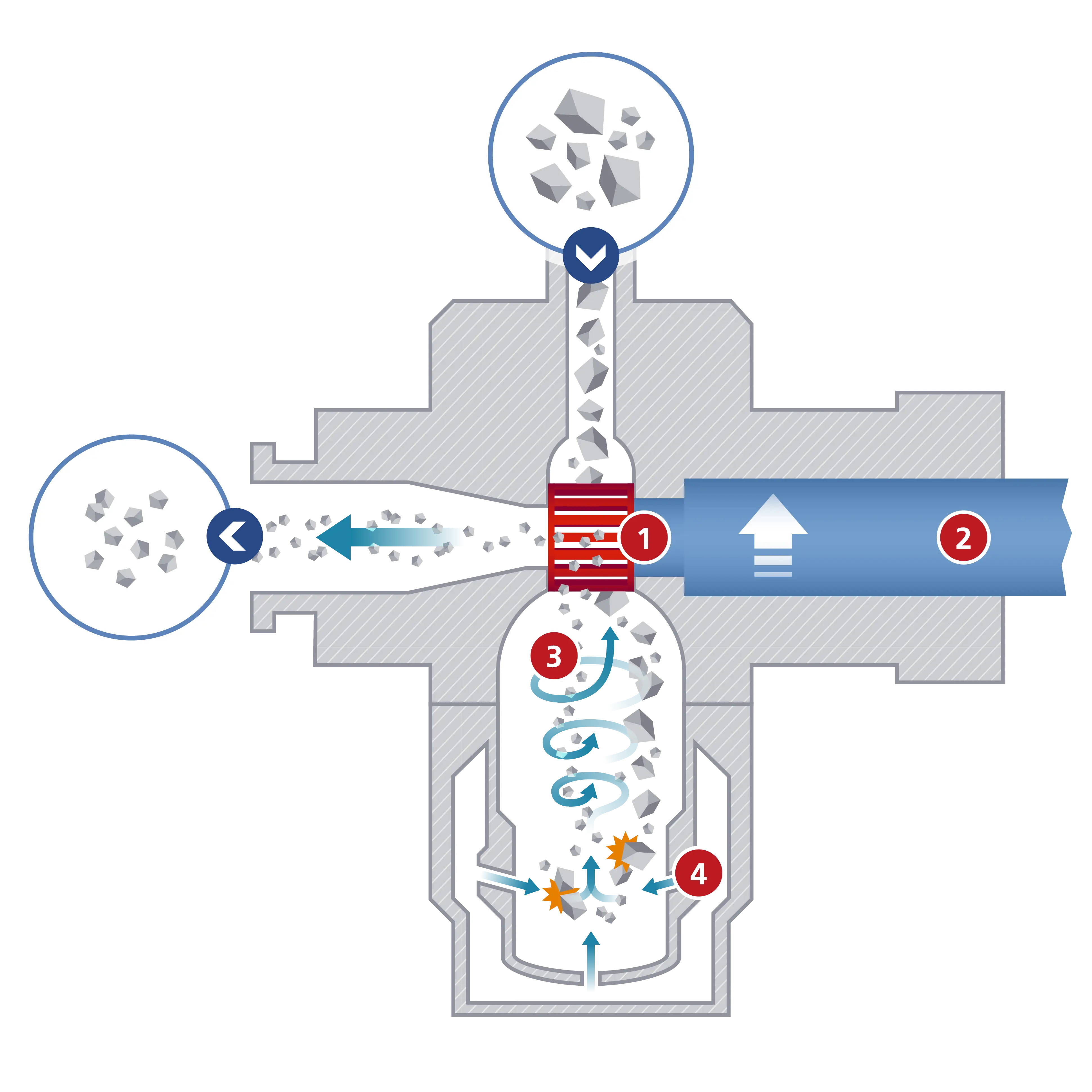
- The grinding energy is introduced by highly accelerated air jets via several grinding nozzles.
- The ground material is dosed into the grinding container and fluidised by the air jets. The particles are accelerated by the air jets that meet at the focal point. Size reduction is achieved by particle impact at the focal point and by shear flows at the edges of the air jets.
- The grinding air then flows through a classifying wheel located in the head of the mill, where classification takes place. Due to the classifying wheel with air, fine particles can escape from the grinder with the air and are separated in a filter. Coarser particles fall back into the fluidised bed and are crushed further until they have reached the desired fineness.
- The fineness is set via the air volume, the grinding air pressure and the classifier wheel speed.
1 Classifier wheel 2 Classifier drive 3 Grinding chamber 4 Process air

Piconizer spiral jet mill
For soft to medium-hard products
- Spiral jet mill for dry grinding of soft to medium-hard materials
- Archiving of process data in the platform
- Compressed air or inert gas operation
- Lid with integrated static classifier and integrated nozzle ring with four nozzles and grinding air connection
- Nozzle ring with dead space-free milled nozzles
- Mill housing with integrated injector for material feed
- Tubeless grinding and injector air supply through platform adapter
- Designs: Stainless steel and wear-protected (ceramic) variant
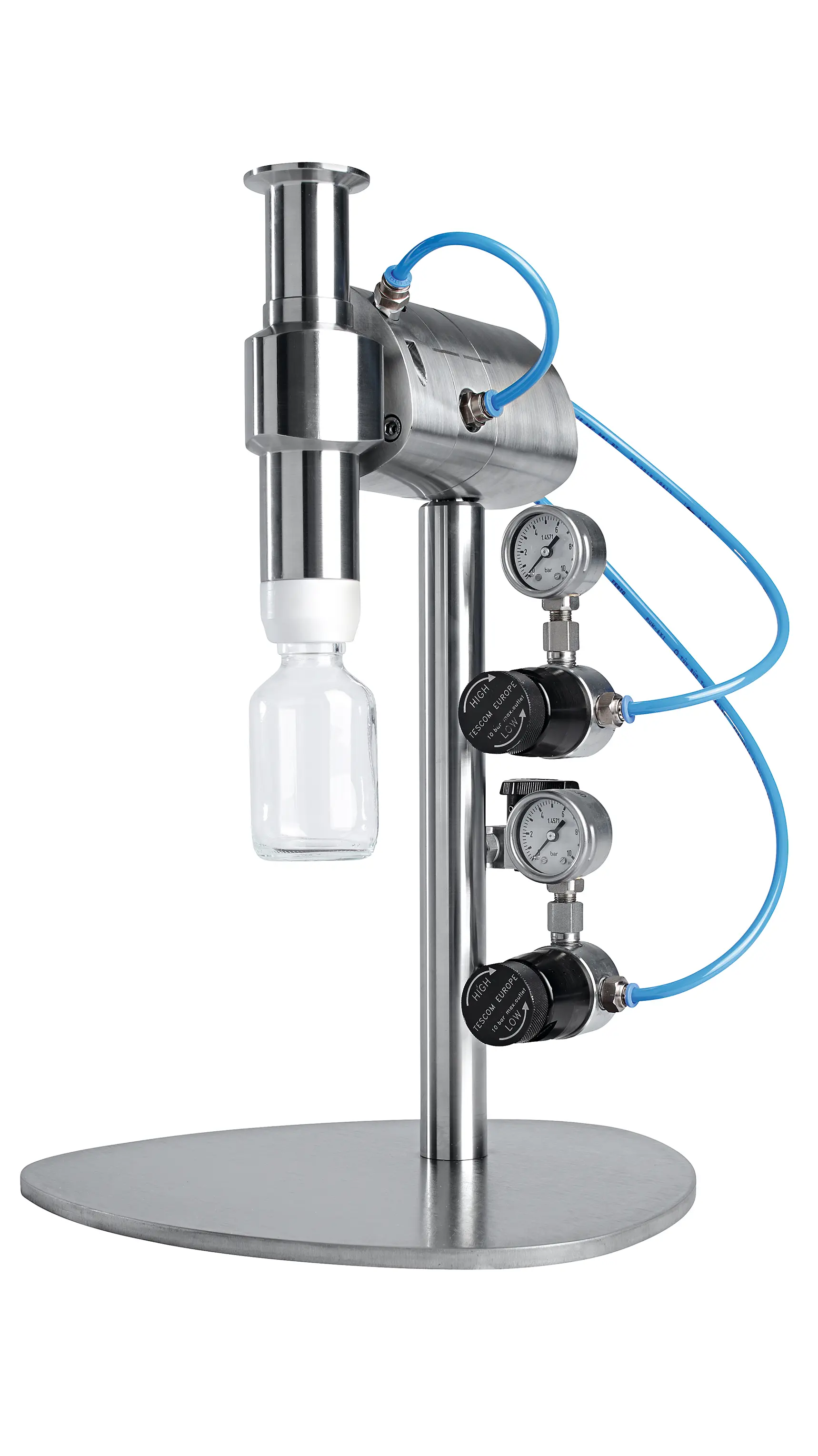
- Also available as a stand-alone version without platform: Electroless version purely via compressed air, control via manual valve, small space requirement
- The design and mode of operation largely correspond to the AS series from Hosokawa Alpine
Technical specifications
|
Separation range |
5-40 µm |
|---|---|
|
Grinding to Mohs hardness |
3-8 |
|
Grinding air volume |
33 mm |
|
Grinding air volume |
max. 4 Nm³/h |
|
Propellant air volume |
max. 1 Nm³/h |
|
Grinding air pressure |
2–9 bar O |
|
Motive air pressure |
2–9 bar O |
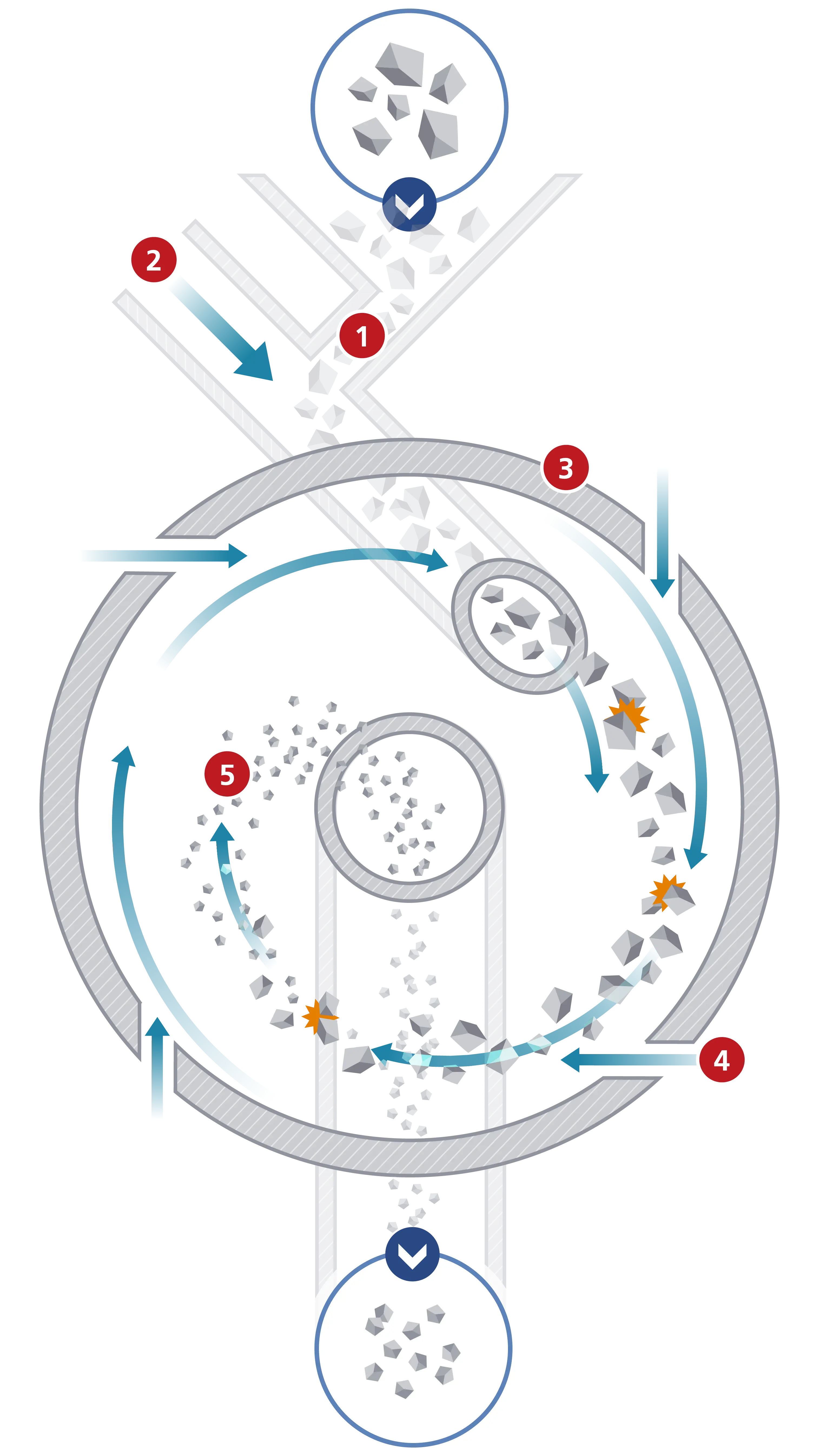
- Several gas nozzles are used to generate a rapidly rotating vortex of air. The ground material is fed into the disc-shaped grinding chamber via an injector.
- The comminution takes place through particle collisions caused by the velocity gradients in the air flow.
- The grinding gas is discharged through an immersion tube located in the centre of the grinding chamber. The potential vortex flow creates a classifying effect so that only fine particles can leave the grinder through the immersion tube and are separated in a cyclone filter combination, cyclone or filter. Coarser particles remain in the grinding chamber until they have reached the desired fineness.
- The grinding gas quantity, the grinding gas pressure and the throughput can be varied to set the degree of micronisation.
1 Injector 2 Injector gas 3 Nozzle ring 4 Grinding gas 5 Grinding zone
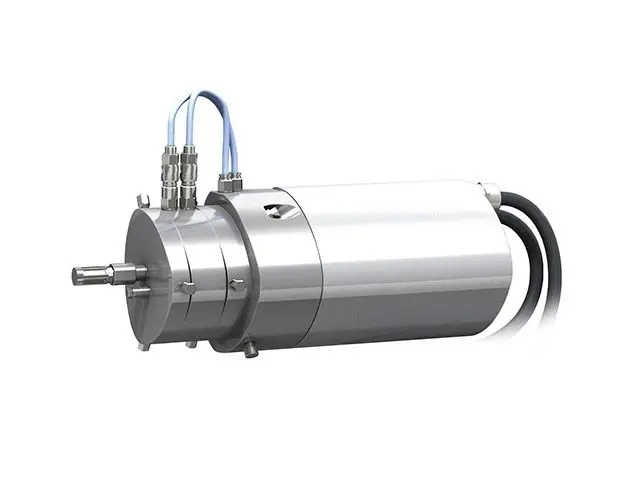
Picobond high-energy mixer
Mechano-chemical functionalisation of dry particles
- Mixing reactor for the mechano-chemical functionalisation of dry particles (particle design)
- Mixing or intensive mixing (coating) possible
- Segregation prevention through mechanofusion
- Protection against product heating through process chamber cooling
- Can be purged with inert gas
- Easy filling and emptying
- Measuring devices for influencing the desired product quality (product temperature, rotor speed, motor power)
- Batch mode
- Parts in contact with the product are made of stainless steel
- Designs: Mechanofusion rotor with stator lid or inclined blade agitator, for contamination-free preparation
- The design and mode of operation largely correspond to the Nobilta from Hosokawa Micron B.V. or the AMS series from Hosokawa Alpine
Technical specifications Picobond NOB
|
Process chamber volume |
approx. 220 ml |
|---|---|
|
Rotor drive |
630 W |
|
Rotor diameter |
40 mm |
|
Speed |
max. 8,000 rpm |
Technical specifications Picobond AMS
|
Process chamber volume |
approx. 190 ml |
|---|---|
|
Rotor drive |
630 W |
|
Rotor diameter |
40 mm |
|
Speed |
max. 7,300 rpm |
- The powder mixture is completely centrifuged by the rotor and moves as a circulating ring layer along the inner wall of the mixer housing.
- Stresses such as pressure, shear, impact and rebound are initiated within the compacted component fill in this ring layer.
- On contact with the following rotor element, the direction of action of the transmitted pulse changes. This creates a complex, three-dimensional material circulation, which causes intensive, repeated pressure, impact, bounce and shear stress as well as intensive mixing of the material.
- The high energy input into the mix compared to conventional mixing systems causes particle fusion, coating, agglomeration and particle rounding in addition to the basic operations such as macro and micro mixing.
- The powder mixture is forced into the gap between the rotating rotor and the stationary stator, whereby the stress mechanisms of pressure and shear occur.
- The formed edge layer is then separated from the inner surface of the rotor by a scraper and leaves the rotor through the side openings.
- In the outer area, the blades attached to the rotor cause a return transport into the processing area.
- This results in a permanent circulation of the material in the machine, which leads to the most homogeneous loading of the particle mixture possible.

Picomix batch mixer
Homogeneous mixture of dry powders
High-performance batch mixer for dry powders- Inclined blade mixer in vertical conical design
- Process chamber can be cooled by external unit
- Shaft seal with flushed shaft seal ring
- Measuring devices for product temperature, rotor speed, motor power
- Parts in contact with the product are made of stainless steel
- Batch mode
- Based on the Cyclomix from Hosokawa Micron B.V.
Technical specifications
|
Useful volume |
20-100 ml |
|---|---|
|
Speed |
max. 6,000 rpm |
|
Mixer drive |
630 W |

- The rotating mixing tool is arranged in a conical mixing container.
- The special geometry of the mixing tool and the high shear rate ensure intensive, homogeneous and rapid mixing of the powder components.
- The components to be mixed are filled into the mixing container and the machine is then closed.
- After the mixing process, the container is removed from the machine and the finished mixture is emptied.
- The mixing quality is set via the rotor speed, the mixing time and the filling quantity.
1 Mixing tool 2 Mixing tool drive
Stand-Alone Solutions
Do you want to run the individual processes without a platform?
- Operation without a platform is possible – processes are fully functional even without a central platform
- The latest version of Picoline ensures simple and reliable implementation
- Targeted, task-specific solutions can be used for individual processes
- Manual process control for maximum flexibility
- Cost-effective entry into the world of microprocesses
- Highly accurate control
- Archiving of process data in the platform
- Automatic process control
- Dosing and vacuum cleaner are controlled automatically
- Cost-effective solution for a power-free version using only compressed air, without dosing
- Reduced space requirements
- Manual control via hand valve
- No data recording
Containment
- For optimum protection of plant operators from the processed product, we also offer the Picoline integrated into an isolator
- This allows all processes to be operated under a protective atmosphere (< 1% O2 ) and OEL values of up to 50 ng/m³ to be achievedn

System accessories
Expand your Picoline to suit your application
Various peripheral devices are available for your Picoline. Which accessories you choose depends on the respective application:
- Processing of dry powders or flowable suspensions
- Operation mode: with compressed air or inert gas, batch or continuous, design variants: Wear-protected (ceramic and coating), containment solution

- The PMD screw feeder is suitable for precise, continuous product feeding
- Four different screw flights for flexible application options
- A wear-protected version with ceramic coating is available

- The PDR pharmaceutical dosing tube ensures gentle product conveying by means of vibration
- The dust-tight design guarantees very easy cleaning
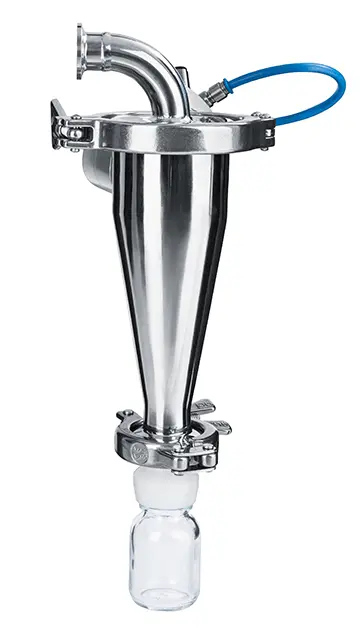
- The cyclone is suitable for separating the product before the filter
- Guarantees easier product extraction
- Quick to clean

- Flexible, needs-based standard filter equipment
- Optionally also available with filter hoses or filter cartridges
- On request with Safecoat coating as wear protection for highly abrasive products
The Hepa filter is recommended for processing toxic and other critical materials to protect employees and the environment (filter class H13)
- The vacuum cleaner provides the necessary negative pressure in the grinding and classifying processes
- It is started and stopped by the Picoline
- The PSD small-volume feed metering unit ensures continuous product feeding for maximum process stability
- Six different reversible dosing discs are available
- The KF cold screw conveyor is suitable for the use of liquid nitrogen in cryogenic grinding processes
- Also suitable for very sensitive or difficult-to-grind products
- The temperature control unit cools or heats the Picobond and Picomix modules within a temperature range of 5 – 70 °C
- Collection container with thread and lid, available in various sizes
