Solids process automation
Automation in plant engineering for bulk solids handling
Bulk solids are stored in silos, big bags or containers equipped with automatic discharge systems to ensure reliable extraction of the required product amount from the container. In case of higher outputs, the bag emptying is performed automatically. With smaller outputs, the manual emptying process is usually supported by mechanical devices (e.g. hoists).
Automation and conveying:
In the field of conveying bulk solids, which includes both mechanical systems (e.g. screw conveyors, bucket elevators, trough chain conveyors) and pneumatic systems (e.g. pressure conveyors, vacuum conveyors, air slide conveyors), the use of automation technology has the greatest influence on production and productivity. Here, even large quantities of bulk solids can be transported reliably and safely over long distances without human intervention.
Automation and dosing, automation and weighing:
In the field of dosing and weighing, automation positively influences the quality of products through higher levels of dosing accuracy as well as increasing productivity. Of particular importance here are the production logs and batch records that the recipe control system saves for archiving.
An upgrade in time is worth it
Out-of-date touch panels and SPS-memory can be a risk to your production over time. If a manufacturer takes a generation of control systems off the market, this can cause problems with support and the availability of spare parts. Avoid those issues and modernize your machine’s control system sooner rather than later!
Updating your control system technology is fast and straightforward. Depending on the model and age, we can easily update your control system or if unnecessary, upgrade it with better, higher performing components.
The advantages of modernized control system technology:
Upgrade from S5 to S7 technology for multi-panel or PC control
Safer control, formulation management and remote maintenance
Improved energy measurement and archiving of production data (ISO)
Upgrading of sensor technology and plain-text error messaging
Better energy efficiency with new control algorithms and frequency converters
Guaranteed product quality
Our range of products and services includes
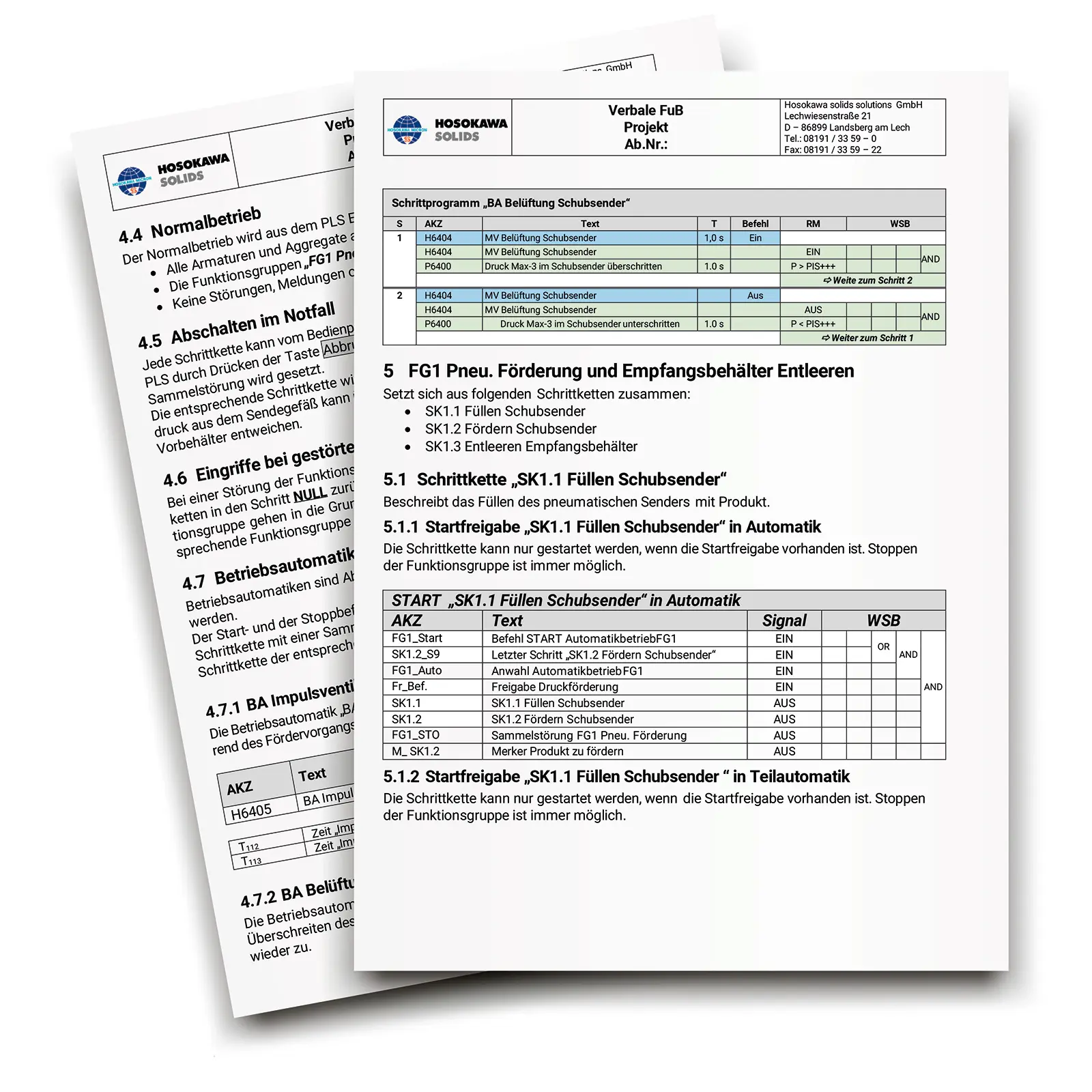
We plan our process flows in a graphical format based on EN 60848. This is used to describe a process sequence together with its function groups, individual steps, control steps, step enabling conditions, interlocks and start conditions.
This simple description of the control sequences has the advantage that anyone working on the plant can easily follow and comprehend the sequences and dependencies of the process engineering.
We describe individual release conditions and interlocks in a text format or decision matrices, allowing for a simple overview of all the processes that are important for protecting the plant.
The description in this format can also be incorporated into the operating manual.
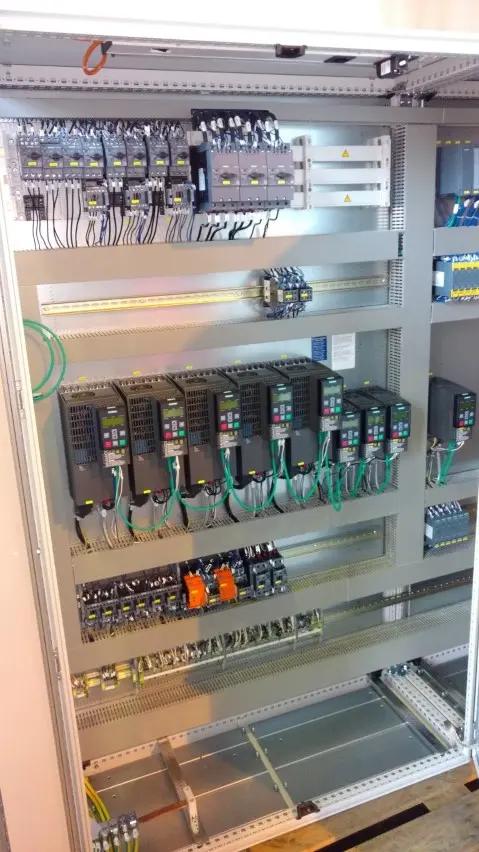
We prefer to use the latest generation of PLC systems from Siemens for automating our bulk solids systems. These control systems monitor the sensors connected to the inputs of the switchgear and, depending on their value, control the actuators connected to their outputs according to the programme. Pressure sensors, temperature detectors, limit switches, rotational speed detectors, etc. can be used for inputs. The outputs control motors and actuators. The control has AND/OR functions, counters, markers and timers. This means that it can also act in a time-dependent manner. The use of a programmable logic controller allows control and regulating functions to be performed. We prefer to solve complex weighing processes using the Siwarex series from Siemens. Integration into customer-specific process control systems or communication with systems from other manufacturers is solved via standardised bus systems such as Profinet.
Advantages
- Efficient programming
- Widely used technology and therefore minimal training requirements
- Easily adaptable to individual customer requirements
- Fast and cost-effective plant service through remote maintenance via VPN.
Design of an electrical plant control
- PLC S7-1200 - S7-1500 (programmed with TIA V16 or higher) or made according to customer requirements
- incl. visualisation
- Signal exchange to process control systems as required: Potential-free contact exchange or bus systems such as Profinet
- Standard software that can be configured/parameters adapted
- Integration of weighing/dosing processors (e.g. Siwarex series)
- Open access to program with comments, therefore available for customer changes/modifications
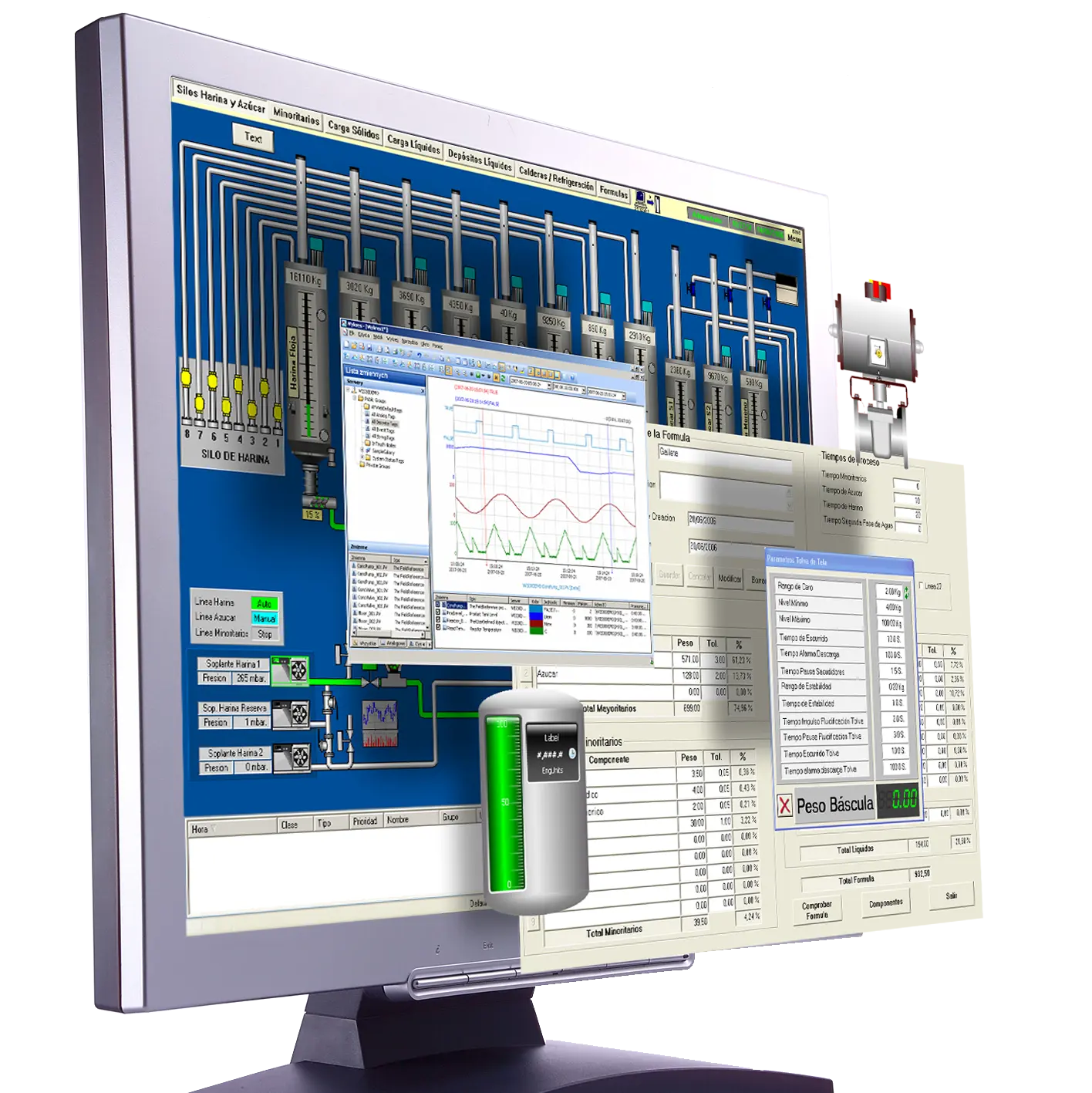
The process visualisation is used to display the operating states and to operate the system. Using diagrams for overview and details, you always have an eye on the system, exactly as you need it. Operation is simple via touchscreen or optionally with a mouse and keyboard. This means that a detailed overview of the current system status is possible at any time.
In the detailed diagrams, the current unit operating states are marked in colour (unit not switched on, unit started, unit reported back, unit faulty). Several different parameters for the individual units can be displayed and modified if required. Analogue measured values as well as binary signals (process data) can be manually displayed as time diagrams or permanently integrated into the diagrams.
We prefer to use the visualisation systems from Siemens.
In a protected operating mode, the units can also be switched on and off without being locked. This is also possible in the manual function. Faults are indicated in an error list by a appearing and disappearing message (unit no., error text and date and time). Error messages are also archived in a log file programme and can be statistically evaluated there.
Advantages
- Detailed overview of the operating statuses at all times
- Easy access to recipes and parameters for adjusting the system to the product
- Graphical overview of the conveying processes
- Archiving and traceability of loading and system statuses
- Fast fault localisation through descriptive fault texts and unit identifiers
The control room is the heart of every installation – where all the signals from the production and ancillary processes converge and where the plants are automated and the processes synchronised.
The process control system is used to control a process plant using:
process-related components,
the operating and monitoring stations and
the actual freely programmable control system with batch programme
The process-related components (sensors such as pressure transmitters, and actuators such as control valves) perform the control and regulation tasks.
The operating and monitoring stations serve to visualise the process plant and are connected to the process-related components via a bus system.
The process control system is used for production planning, production data acquisition, master data management and much more.
Automated process sequences are displayed graphically and executed on a programmable logic controller (preferably Siemens).
The system takes into account the special requirements of the industry in terms of variable recipe control, i.e. a free combination of material components and control parameters (control recipe and material recipe) is possible.
Additional modules also allow for the calculation of process costs, which result from the individual actual run times of the control steps and the known fixed and variable costs. Forecast calculations on run times and costs are also possible here.
Required control steps are defined by configuration and definition of the necessary parameters, connected to the PLC via a standardised interface.
Master data such as articles, recipes, control recipes, material flow paths, cells/tanks/silos and scales are managed. It is possible to create production orders, define production batches as well as assign and then start required resources. After production, the process data is logged.
Support for the operating staff can be provided quickly and easily via remote maintenance. In the event of a malfunction, the cause of the malfunction can be located at any time and at short notice via remote maintenance, allowing production to be resumed.
Management of a process plant
Fast and cost-effective plant service through remote maintenance
- Installation on site, including cabling, electrical commissioning (loop check, rotation check), process commissioning
- Training for operating and maintenance staff